1. Three beats
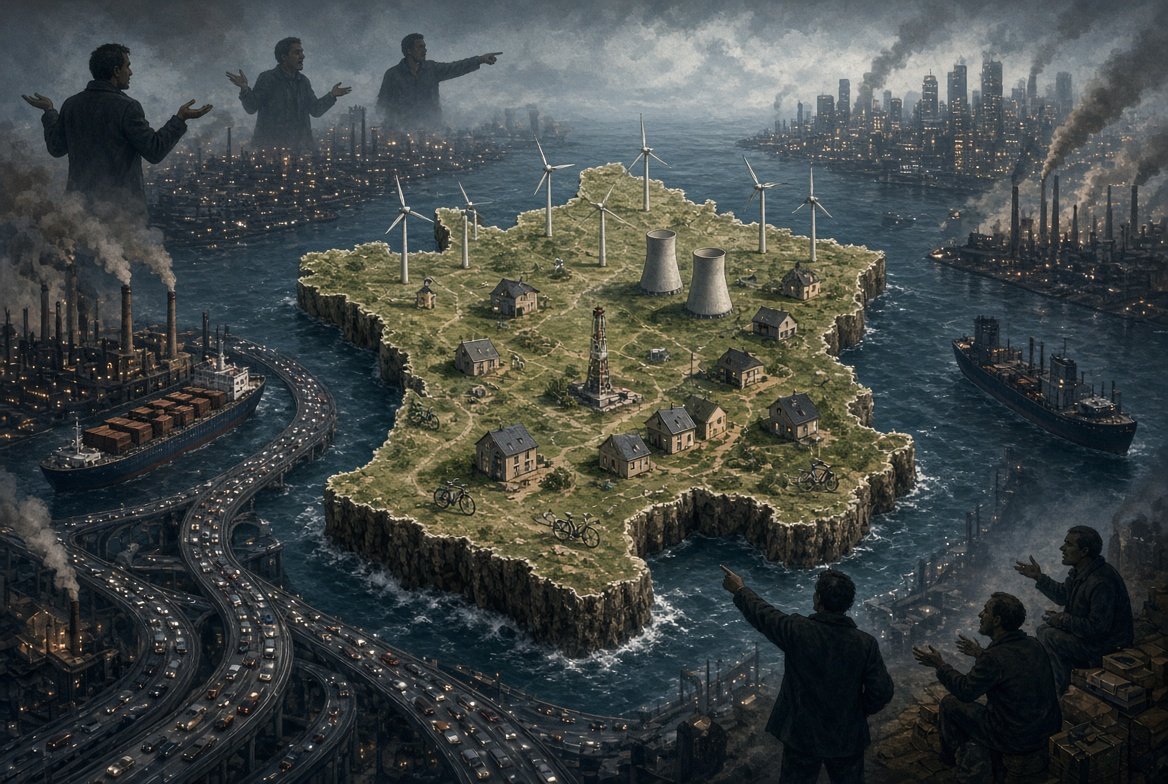
France is 0.8% of the world population, about 0.7% of fossil CO2, and under 1% of greenhouse gases once imports are counted. That weight rejects two comfortable lines at once: “France saves the climate by example” and “France is too small to act.”
The note holds three beats. The French effort is justified first by what it returns in France: a lower import bill, less exposure to shock, deaths avoided. The climate effect depends on what others copy. People copy what is cheaper and simpler. They rarely copy what is only meritorious.
2. The number that commands
One comparison organises the rest, and it is where the oral hearing and the official Senate minutes differ. Final energy on the territory is about 1,600 TWh; the SDES provisional balance for 2025 gives 1,495 TWh. With the energy embodied in imports, Jean-Marc Jancovici said 2,600 TWh; the written minutes say 2,500 TWh. Nuclear produced 373 TWh in 2025: a quarter of territorial final use, about a seventh of the lifestyle. Electrification helps — an electric motor does three to four times the work of a combustion engine, and about 300 TWh of the 450 to 500 TWh of transport can move that way; a heat pump beats a gas boiler — and it does not reverse the ratio. The hearing’s own step is from about 360 TWh of nuclear toward a significant share of the 2,600. That still leaves a large sobriety. Reindustrialising tightens it, because industry takes its share of the energy that households would otherwise use.
On the world scale the hearing is harsher. Nuclear is about 10% of world electricity, and electricity about 20% of final use, so about 2% of uses. The spoken line is that this, or nothing, is nearly the same. Replacing 2,200 to 2,400 GW of coal would take tens of times the present fission fleet, and uranium-235 does not cover a few centuries, which is why generation IV is in the chain. The good electric car in this arithmetic is an electric bicycle. The good future plane is a train. The speaker calls himself “un décroissantiste pronucléaire”. The mean footprint, 8.2 tonnes in 2024, against a Paris-compatible order of about 2 tonnes, is a division by four that neither a boiler nor a car change produces alone.
| Quantity | Figure | Reading |
|---|
| Territorial final energy | ~1,600 TWh (SDES provisional 1,495 TWh in 2025) | What is used on French territory |
| Lifestyle, imports included | 2,600 TWh spoken / 2,500 TWh in the minutes | What the way of life actually calls |
| Nuclear production, 2025 | 373 TWh | A quarter of the territory, about a seventh of the life |
| Mean footprint, 2024 | 8.2 t CO2e per person | A Paris-compatible order is about 2 t |
| World fossil CO2, 2025 | +1.1%, to 38.1 Gt | French territorial CO2, 264 Mt, is under eight months of that rise |
Orders from the hearing of 27 May 2024 (video zp4O9Pa-cEY and the Senate minutes) and from the 2025–2026 public balances cited in the note. Spoken 2,600 TWh and minuted 2,500 TWh are both kept. The chain itself is the final DFKPS link.
3. Work on ourselves
The hearing calls humans lazy and accumulative animals. Fossils bought more status with less effort. Status marks a place in the hierarchy — if it meant nothing, the senators would not be sitting there. The work is on signs of status, on meaning, and on positive feeling, in a form compatible with sobriety. It is not the engineers’ work. It is done too quietly. It weighs as much as the wind-and-nuclear debate, because no technical margin absorbs unlimited accumulation.
Six published results say how that work actually moves. The virtuous person is disparaged before being followed: Minson and Monin found that 47% of meat-eaters spontaneously produced a negative term about vegetarians, and hostility rose with the moral judgement they felt. The same months’ banking tallies still show on the order of 94.5 million dollars an hour to fossil fuels since 2016, and 8,700 billion dollars over ten years from 65 banks. Each person thinks they are already sober and that others are not. In the ADEME barometer, about 4,000 people, 83% say France consumes too much, 28% say they themselves do, and 82% judge their own life already sober. Across 125 countries and 129,902 people, 69% would give 1% of income and 89% want more political action, yet they underestimate willing fellow citizens by 26 points. The first cheap work is to say what others already think. A norm described as moving beats a norm described as settled: in a Stanford café, “people limit meat” led to 17% meatless choices, and “people are starting to reduce” to 34%. A neighbour’s solar roof raises the chance of the next one, strongest at street scale. Status can move onto a green product when the choice is public — and a costly green object, such as a two-tonne electric car, rebuilds the accumulation the hearing wants to leave. In the lab, a committed minority near a quarter can flip a convention. That is not a direct transfer to a whole lifestyle. It does say that not everyone must be convinced first.
Five works follow. Count consideration in units that sobriety can win: kilowatt-hours per square metre per year, the age of an appliance still in service, kilometres without a motor, a stable energy bill. The engineer does not do the cultural work, but can supply a unit people can compare. Make the invisible visible. A surface-geothermal probe, about 100 metres under the garden, removes the fossil boiler and shows the neighbour nothing — so publish the visit, a plate on the facade, the bill in the hall, the condominium statement. Say what is changing, when it is true. Expect the disparagement and do not return it: answer with measured kilowatt-hours and litres, and do not judge those who have not changed. Look for satisfaction somewhere other than renunciation: repair, a trade, heat that depends on no supplier, time, a skill passed on. That last one moves by story and example, not by rule.
4. Weight, record, and what the effort returns here
Since 1990, emissions of resident units are down 31% and the footprint 20%. Territorial emissions for 2025 are estimated at 359 Mt CO2e, minus 2.1% in one year. Metropolitan electricity was 95.2% low-carbon, with a record export surplus of 92.3 TWh. Energy independence reached 62.7%, the highest since 1970. In the winter of 2022–2023, electricity use fell about 9% against a normal-temperature winter, some 20 TWh, with no new technology, in the first year of the sobriety plan; the ministry counted about 12% cumulative on gas plus electricity. A change of use of that size can happen in one season when the reason is understood and everyone knows the others are complying. The limits are as particular as the record. The SNBC 3 aims at 274 Mt in 2030, about 5% a year for five years from 359 Mt, against 2.1% in 2025. Transport is still first, at 123 Mt. Fossils were still 58% of final energy in 2023, against a PPE 3 target of 40% in 2030. About half the footprint is emitted outside the territory, inside imports.
Per person, resident-unit emissions (5.9 tonnes) sit under a world mean near 7 tonnes. The footprint, 8.2 tonnes, sits about one sixth above that mean. The target of 2 tonnes is far in both cases. The 1% argument fits almost every country. Only six states emit more than 2% of world CO2 each. The rest, together, emit 36%, more than China. If every country under the threshold waits, more than a third of the problem has no owner. French smallness is real and shared, which removes it as an excuse and does not turn it into a lever. A France brought to zero overnight would be erased in under eight months by the 2025 rise in world fossil CO2 alone. States are not aligned: China 32%, the United States 13%, India 8%, the European Union 6%, and all four rose in 2025. The United States left the Paris agreement a second time and skipped COP30; the final decision there does not name fossil fuels. Current policies point near 2.8 °C, and the deposited national pledges near 2.3 to 2.5 °C. Populations and prices tell another story. Renewables produced 33.8% of world electricity in 2025 and passed coal at 33.0%. Fossil power fell 0.2%. One new car in four is electric or plug-in, more than one in two in China. Thirty-five countries cut emissions for ten years while their economies grew. Almost none of that comes from admiring another country. It comes from the price of the panel, the battery and the kilowatt-hour. French ambition should be set on that fact.
The effort has a first justification that does not depend on any other country. In 2025 the French energy bill was 45.8 billion euros, down 21% in a year: about 670 euros per inhabitant paid abroad, mostly for oil and gas. Each fossil kilowatt-hour avoided cuts that outflow whatever China or the United States does. The year 2026 showed the cost of dependence. After the Middle East war began on 28 February, oil traffic through the Strait of Hormuz fell from about 20 million barrels a day to 2.7 million on average from March to May. North Sea crude hit 144 dollars a barrel in early April. IEA members released 400 million barrels, and world oil demand fell by nearly 5 million barrels a day in the second quarter. Nobody chose that drop. Sobriety has two forms: the one that is organised, and the one that is suffered. The first leaves the order and the pace; the second arrives without notice on those who have no substitute. Santé publique France attributes nearly 40,000 deaths a year to fine particles in people aged 30 and over, at an assessed cost of 130 billion euros a year, largely from combustion in engines and heating. The climate benefit of the French effort is global, delayed, and conditional on imitation. The economic, health and strategic benefit is local, fast, and acquired in every case. Encouragement founded on the second still holds if the rest of the world is late.
5. An exportable laboratory
A Shift Project plan, drawn up by more than fifty experts and summed up in public in September 2026, speaks of about 50 GW of nuclear in 2050, renewables taken toward 250 GW, a shift to the bicycle and the railway, lighter vehicles, less flying, and finance on the order of 100 billion euros a year. The same account states its own bounds: the plan aims above all at territorial neutrality, while the footprint, imports included, is clearly higher; France is about 1% of world emissions; the real effect depends on imitation. Slowing French activity hard, in order to set an example while waiting for others, is a fragile strategy. The relative weight is too small for the signal to carry. Elsewhere, catching up on energy is an aspiration of living standard, which the example of a rich country does not suspend. A weakened country exports fewer solutions. The hearing says reindustrialisation increases the sobriety required of households, because industry takes its share of the available energy. It nowhere says production should be given up. Waiting for the large emitters to move runs into the arithmetic above and into the local bill. Between the two, France can be a laboratory whose results get copied because they cost less.
Three means. Consumption: half the footprint is emitted abroad, so what is bought, kept longer, or not bought touches emissions outside the territory. That is how 0.8% of the population reaches further than 0.6% of territorial emissions. Production: making a good with electricity that is 95% low-carbon emits less, product for product, than making it on a coal grid. Since 1 January 2026 the EU carbon border adjustment applies in its definitive regime to cement, steel, aluminium, fertilisers, electricity and imported hydrogen. For those goods the effort stops being unilateral: the importer pays the carbon price at the door of the European market. Know-how that can be sold: nuclear, grids, surface geothermal, training. PPE 3 sets, for 2030, 10 TWh of heat from geothermal heat pumps and 6 TWh of deep geothermal. Several links — drilling, equipment, skilled labour — are still pre-industrial. Industrialising them here lowers the cost for everyone who will take them up.
Carbone 4, in 2019, measured what an individual can do. On a mean footprint of 10.8 tonnes (2017 data), a behaviour called heroic, stacking every gesture, removes 2.8 tonnes, or 25%. Add private investment — renovation, a change of heating, a vehicle — and the share reaches 45%. In a realistic case, gestures weigh 5 to 10% and the whole about 20%. Between half and three quarters of the effort sits with the state and with firms. That split ends the quarrel between small gestures and the grand plan. A fifth to nearly half of the path is within reach of households: not everything, and very far from nothing. The rest will not happen without them either, because the same people vote, buy, and work in the firms concerned. Useful changes are those that remove a real fossil demand: an electrically assisted bicycle instead of the second car, insulation and a geothermal heat pump, goods kept longer, kilometres removed rather than merely decarbonised. Diet is the first individual gesture by weight, about 10% of the footprint in that study. These gestures will be criticised for what they leave standing. That reaction is expected. Firms and institutions contribute by making the new habit cheaper and simpler than the old one, by counting the net gain rather than the remaining inconsistency, and by publishing what the French actually do. Sobriety stops being the business of the already convinced only on that condition. The nuclear-versus-wind debate is not to be set against the work on status signs. The hearing places them at the same rank.
6. Six proposals
- Found the public case for the transition on what it returns in France — the bill, security of supply, health — and present the climate effect as what it is: real, global, and dependent on others taking it up.
- Treat disparagement of the virtuous as an expected, documented cost. Answer with the measured net gain. Do not claim perfection, and do not judge those who have not changed.
- Tell the French what other French people already do and think. The 26-point gap between real support and perceived support is the first brake that can be lifted without spending.
- Multiply changes that have a physical effect — fossil kilowatt-hours avoided, a stabilised bill — and make them visible, especially the ones that do not show, such as geothermal heat.
- Industrialise, in parallel, the parts that make those changes less painful and less expensive, so that sobriety is not reduced to a loss of status.
- Make France neither a sacrificial example nor a free rider. Make it an exportable laboratory, knowing that the world will take up a solution because it costs less.
References used in this selection
- Hearing of Jean-Marc Jancovici, Senate, 27 May 2024 — video zp4O9Pa-cEY and official minutes. youtu.be/zp4O9Pa-cEY · senat.fr
- SDES, provisional energy balance of France for 2025, and RTE, Bilan électrique 2025. SDES · RTE
- Dugast & Soyeux, Faire sa part?, Carbone 4, June 2019. carbone4.com
- ADEME barometer on sobriety, and Andre, Boneva, Chopra & Falk, Nature Climate Change, 2024. ADEME · Nature
- Global Carbon Budget 2025 and Ember, Global Electricity Review 2026. CSIRO / GCP · Ember
- IEA commentary on the Strait of Hormuz shock, 22 June 2026, and Santé publique France on air pollution, 13 October 2025. IEA · SPF
- Minson & Monin, 2012; Sparkman & Walton, 2017; Bollinger & Gillingham, 2012; Griskevicius, Tybur & Van den Bergh, 2010; Centola et al., 2018. Banking on Climate Chaos, 2026. bankingonclimatechaos.org
- Base dossier of this selection: François Dorléans, EE-NOTE-TNH-001, revision 1-C, 7 October 2026. The numbered bibliography, the acronyms and the index stay in the PDF.
Acronyms
ADEME — French agency for the ecological transition. CBAM — EU carbon border adjustment mechanism. CO2e — carbon-dioxide equivalent. COP — Conference of the Parties, and also, elsewhere on this site, a coefficient of performance. GCP — Global Carbon Project. IEA — International Energy Agency. Mt / Gt — megatonne / gigatonne. PPE — French multiannual energy programme; PPE 3 covers 2026–2035. RTE — French transmission system operator. SDES — statistical service of the ministries for environment, energy, housing and transport. SNBC — French national low-carbon strategy. TWh — terawatt-hour, one billion kilowatt-hours.
The demonstration, point by point
The last link decomposes Jean-Marc Jancovici’s demonstration at the Senate on 27 May 2024. Fusion’s timetable. What can be dispatched, and what cannot. Hydro already at the stop. Use that must follow the wind and the sun, or else curtailment and negative prices. Nothing that stores a summer into winter. A turbine that is fast, and a grid that is not — Germany has already spent twenty years. Nuclear as the inverse: a hard plant, a simple grid. Coal still at 2,200 to 2,400 GW, so fission would have to grow by tens of fleets, and uranium-235 does not last the centuries, which brings generation IV. About 2% of world uses, so that this or nothing is nearly the same. Then the French figures: about 1,600 TWh on the territory, 2,600 TWh spoken and 2,500 TWh minuted once imports are in, 373 TWh of nuclear in 2025, a quarter here and a seventh of the life. Electrification helps and does not close the gap. Sobriety stays large, and industry tightens it. The good car is a bicycle. The good plane is a train. A pronuclear degrowther, from 8.2 tonnes toward about 2. And the work on status and meaning, which the hearing sets at the same weight as the machines and does not itself describe.
Spoken 2,600 TWh and written 2,500 TWh are both kept in the deck. Video zp4O9Pa-cEY. Official minutes on senat.fr.
Demonstration · DFKPS