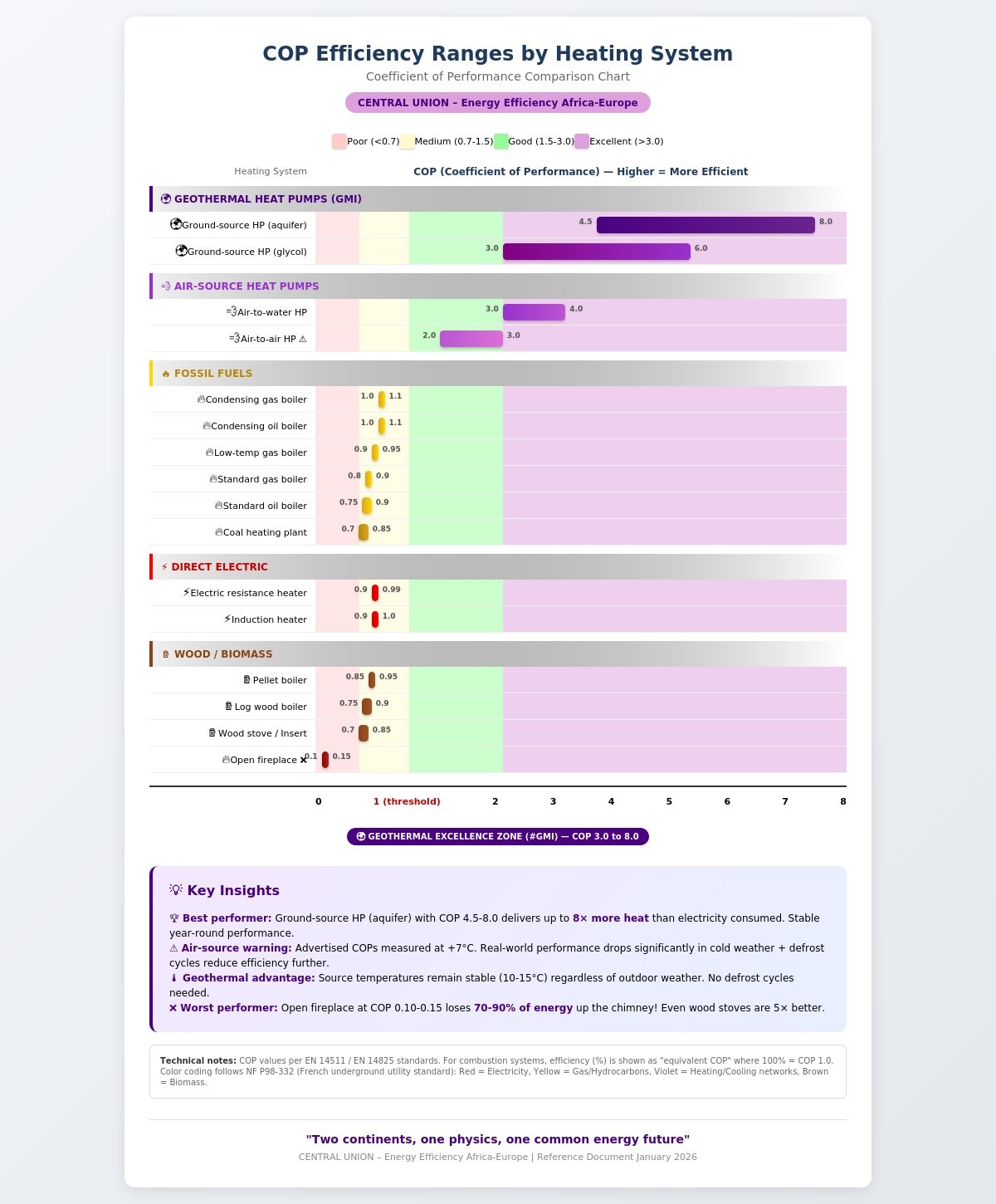
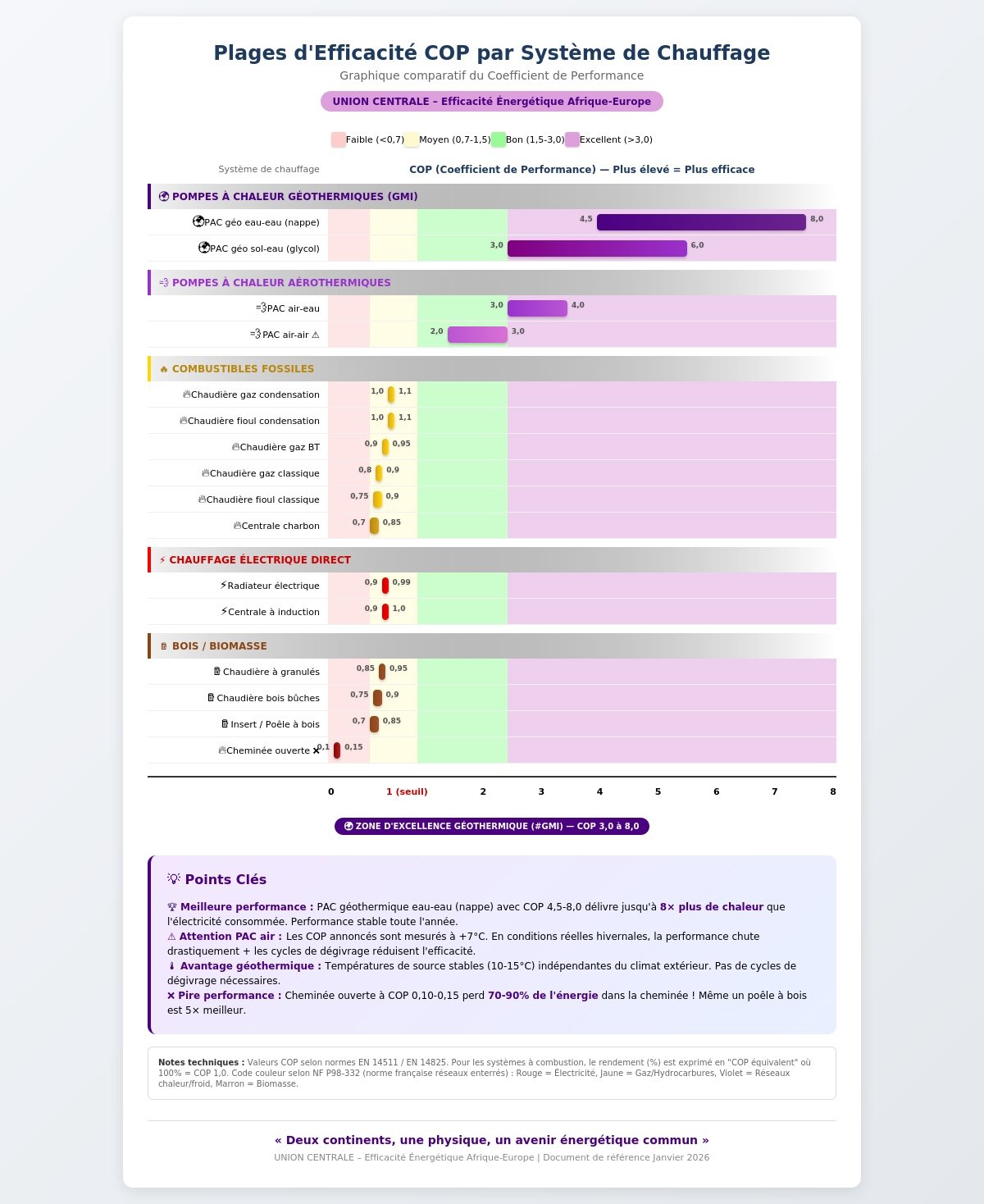
Energy is not infinite. The main criterion that must guide our energy choices is the COP (Coefficient of Performance) — the ratio between useful energy delivered and primary energy consumed.
Update note (Aug 2026): this edition (1) integrates hybrid PVT (Photovoltaic-Thermal) + heat-pump systems that join geothermal excellence with SCOP 4.5–8.5, and (2) clearly separates heating COP from cooling EER/SEER, which are not interchangeable.
Energy colour code NF P98-332: Red = Electricity · Yellow = Gas/Hydrocarbons · Violet = Geothermal · Brown = Biomass — Documentary extensions: Cyan = solar hybrid PVT.
1. Understanding COP and efficiency
COP measures heating-system efficiency. A COP of 4 means that for 1 kWh of electricity consumed, the system delivers about 4 kWh of useful heat (3 kWh drawn from the environment + 1 kWh of electricity).
For combustion systems (oil, gas, wood), efficiency is usually expressed as a percentage. A 90% efficiency means 90% of the fuel’s energy becomes useful heat. For comparison we express it as an “equivalent COP” where 100% = COP 1.0.
Heating ≠ Cooling: heating COP and cooling EER/SEER do not measure the same thing and must not be compared term-for-term. Section 1.1 covers heating; section 1.3 covers cooling.
1.1 COP and efficiency of heating systems
Heating system
COP / efficiency
Equivalent COP
Note
FOSSIL FUELS
Classic oil boiler
75–90%
0.75 – 0.90
Stack losses
Low-temp oil boiler
93–95%
0.93 – 0.95
Adapted emitters required
Condensing oil boiler
100–110% (GCV)
1.00 – 1.10
Latent heat recovery
Classic gas boiler
80–90%
0.80 – 0.90
Legacy standard
Low-temp gas boiler
90–95%
0.90 – 0.95
Notable improvement
Condensing gas boiler
100–110% (GCV)
1.00 – 1.10
Best fossil tech · hydrocarbon dependency
Coal plant (heat)
70–85%
0.70 – 0.85
Highly polluting
WOOD HEATING
Open fireplace
10–15%
0.10 – 0.15
70–90% lost up the chimney
Closed insert / wood stove
70–85%
0.70 – 0.85
Much better
Log boiler
75–90%
0.75 – 0.90
Manual loading
Pellet boiler
85–95%
0.85 – 0.95
Local but particles / logistics
DIRECT ELECTRIC HEATING
Electric resistance radiator
90–99%
0.90 – 0.99
COP ≈ 1; costly to run
Oil-filled radiator
90–99%
0.90 – 0.99
Thermal inertia
Induction plant (e.g. Pereko)
90–100%
0.90 – 1.00
Efficient gas-backup replacement
HEAT PUMPS — HEATING MODE (cooling → §1.3)
Air-to-air HP
COP 2 – 3
2.0 – 3.0
Cold / humidity sensitive · defrost
Air-to-water HP
COP 3 – 4
3.0 – 4.0
Winter drop + defrost
Ground-source HP (glycol) — GMI-GSHP
COP 3.0 – 6.0
3.0 – 6.0
Vertical probes 10–200 m
Ground-source HP (aquifer) — GMI-GSHP
COP 4.5 – 8.0
4.5 – 8.0
Stable source; borehole needed
HYBRID SOLAR PVT + HP — NEW 2026
PVT + water-to-water HP (hybrid, no borehole)
SCOP 4.5 – 8.5
4.5 – 8.5
Air + solar 24/7; no outdoor unit; PV + heat
Legend: Red = low (<0.7) · Yellow = medium (0.7–1.5) · Green = good (>2.0) · Violet = geothermal excellence · Cyan = solar hybrid excellence.
⚠ Critical note on air-source HPs alone: marketed COPs are measured at +7 °C (A7W35). In real winter conditions, performance drops with cold and defrost cycles. A field study is required before claiming annual SPF.
1.2 Focus: hybrid PVT + heat pump systems
A PVT (Photovoltaic-Thermal) panel combines on one surface: front-side PV cells (~18–22% electrical yield) and a rear heat exchanger (water/glycol). Recovered heat (solar + ambient air extraction, 24/7) feeds a water-to-water heat pump as low-temperature source — raising system COP into the geothermal excellence band without a borehole.
High solar self-use, low-temp, optimised conditions
DualSun
DualSun SPRING4 vs PV + air-to-water HP
+20% SPF
Equivalent system comparison
DualSun
IEA SHC Task 60 — real installs
Annual COP 3 – 5
European residential stock, field returns
IEA SHC
Heinöhem retrofit (SE) — PVT + geothermal
Brine +2.8 °C · CO₂ −98%
48 houses + 46 flats, PVT-assisted loop
DualSun / Kraftringen
Rule: never plot or quote PVT panel yield (0.55–0.75) as the heating COP. Quote the hybrid system SCOP 4.5–8.5.
Peak values 5.6 (Triple Solar) and 8.5 (DualSun) are best-case under optimised conditions (temperate climate, low-temp emitters). In winter (source side down to about −10 °C / −20 °C depending on model), the system still extracts heat from air via the panels without an outdoor unit.
Typical sizing
Sizing thumb-rule ~2.5–2.7 m² PVT per kW heat-pump capacity.
Example 10 m² roof/carport: 4–5 panels (~1.6–2.2 kWp electrical) → source suited to a 3.5 kW HP for a well-insulated 4-person home.
All-electric: 4 panels + 3.5 kW HP + 200 L tank.
Hybrid transition: 3 panels + HP alongside existing gas boiler (60–80% gas savings).
Specific advantages vs alternatives
No outdoor unit: silence, aesthetics, fewer planning constraints.
No geothermal borehole: lower cost and ground impact — complementary to geothermal, not a rival.
Double yield (electricity + heat) on the same footprint — critical in Europe and Africa.
24/7 operation, including cloudy or freezing weather (continuous air extraction).
PV cells cooled by rear exchanger: +5–15% electricity and longer module life.
Positioning vs geothermal (#GMI)
Geothermal (aquifer or probes) remains the excellence benchmark for long-term stability, especially on new-build, collective or district schemes. Hybrid PVT + HP is the no-borehole pathway that reaches the same COP/SCOP band for dense urban retrofit and constrained sites.
Buildings: all-electric or hybrid retrofit, no borehole, silent.
Greenhouses: low-temp heat + electricity for pumps/lighting.
Industry < 80–100 °C: preheat, drying, washing, light pasteurisation.
1.3 Cooling: heating COP and cooling EER/SEER are not the same
Cover tables and charts above address HEATING mode only. Cooling follows different physics:
Active cooling (reversible HP): compressor runs reverse. Performance is EER (instant) or SEER (seasonal), typically 2.5–4.5 — not comparable to heating COP 4–8.
Passive cooling (geocooling / free-cooling): only for ground- or groundwater-coupled systems — compressor off (bypass), circulator only. SEER can exceed 14–20 (up to 30–50 depending on design).
System / mode
EER / SEER
Note / source
PASSIVE — GEOCOOLING (no compressor)
Geocooling on geothermal probes
SEER > 20 (up to 30–40)
CEE BAR-TH-178 (JORF 2025)
Geocooling on aquifer (passive aquathermy)
SEER > 14 (up to 50)
CEE BAR-TH-178 · BRGM
ACTIVE — REVERSIBLE HP
Reversible geothermal HP
EER 3.6 – 4.5
CEE min EER ≥ 3.6 (EN 14511)
PVT + HP active cooling
EER ~3 – 4.2 (est.)
Triple Solar cooling module; DualSun EER not published
Reversible air-to-water HP
EER 2.8 – 3.5
EN 14511
Reversible air-to-air HP
EER 2.5 – 3.2
Outdoor temp & humidity sensitive
Aquathermy and “small aquifer geothermal”: what really raises COP
“Aquathermy” is, in professional usage, a public-facing synonym for geothermal on water (aquifer / river / wastewater). Heating COP is not dramatically higher than other low-enthalpy geothermal options of comparable quality.
The real performance step-change is elsewhere: when a ground- or aquifer-coupled system runs in passive cooling (geocooling), and more broadly when source temperature stability is preserved year-round.
In short: aquathermy = water-source geothermal branding; heating COP is not “magic”. Passive geocooling SEER (14–50) must never be sold as a heating COP.
2. Geothermal types and performance
Geothermal uses subsurface heat. Types differ by depth, temperature and technology. This section is unchanged in structure from the Jan 2026 edition, with GMI pathways kept as the long-term excellence reference.
Type
Depth
Temperature
Typical COP
Technology
Example
Very low energy (surface glycol)
0–10 m
10–15 °C
3.0 – 3.5
Horizontal collectors
Lower cost
Low energy (glycol probes)
10–200 m
12–25 °C
3.0 – 6.0
Vertical probes
Small footprint (~1 m / m²)
Low energy (aquifer)
10–100 m
10–20 °C
4.5 – 6.0
Water-to-water doublet
Heat networks
Medium energy (Dogger)
1500–2000 m
60–85 °C
Direct
Doublet
Paris basin
High enthalpy (deep)
2000–3000 m
90–150 °C
Direct + power
Doublet
Alsace, Rittershoffen
EGS / hot rocks
3000–5000 m
150–200 °C
Power + heat
Hydraulic stimulation
Soultz-sous-Forêts
Focus — Eavor-Loop™: multilateral wells meet at depth, forming a closed loop where the carrier fluid circulates without stimulation of the rock mass — a closed deep system pathway complementary to classic doublets.
3. EROI — Energy Return On Investment
EROI (TRE in French) measures how much energy is obtained for each unit of energy invested in extraction and processing of a source.
Energy source
Historical EROI
Current / expected
Trend
Conventional oil (1950)
50–100
4–30 (2022)
↓
Natural gas (1950)
~140
16–40 (2022)
↓
Nuclear
40–80
20–80
→
Hydro
50–200
30–110
Best EROI
Photovoltaic
2–10
8–34 (no storage)
↑↑
PV (with storage)
—
1.6–5
Batteries cost energy
GMI-GSHP (low-enthalpy geothermal HP)
—
20–40
↑↑
PVT + HP (PV EROI proxy, no borehole)
—
≈ 8–34
Indicative — not isolated by manufacturers
Critical threshold: EROI < 7 is considered insufficient to sustain a complex modern economy. Geothermal largely clears this bar with EROI 20–40 on low-enthalpy heat-pump pathways.
4. Efficiency erosion through successive conversions
Every energy transformation incurs losses. The longer the conversion chain, the lower the overall efficiency — which is why direct use of heat often beats long electricity paths.
Conversion chain
Yield per step
Overall efficiency
HOT WATER PRODUCTION
Solar thermal → direct hot water
70–80%
70–80%
PV → battery → electric water heater
20% × 90% × 95%
~17%
GEOTHERMAL
Direct geothermal (doublet) → heat
~95% (pumping)
~95%
Geothermal + HP → amplified heat
COP 4 equiv.
~400%
HYBRID SOLAR PVT — NEW
PVT (elec+heat, same m²) → water HP → amplified heat
SCOP 4.5–8.5
~450–850%
PVT electricity alone → HP self-consumption (no battery)
18–22% captured + reinjected
No battery loss
Fundamental principle: a PVT array feeding a water-to-water HP directly avoids battery storage and its ~90% round-trip — electricity produced is used on-site for the compressor.
Site constraints — borehole land availability vs roof/carport area for PVT.
Geothermal (#GMI) and hybrid PVT + HP systems together offer the best available compromise today: high COP/SCOP, stable renewable source, and pathways adapted to both open land and dense cities across Africa and Europe.
Annex A — Energy economics: beyond “it’s too expensive”
Section structure unchanged vs January 2026. A serious business developer must document technical parameters (COP, EROI, TRL, MRL, CRI, SRL) before negotiating price alone.
PVT note: the PVT chain benefits directly from the PV learning curve (~24% cost reduction per cumulative doubling of modules) — thermal-source integration rides that industrial scale-up.
VIABILITY = f(COP, EROI, TRL, MRL, CRI, Volume, Time, Externalities) — never a single variable in isolation.
Annex B — Technical references and sources
B.1–B.3 (TRL/MRL/CRI/SRL, EROI, COP standards EN 14511/14825/15879-1/16147/12102): unchanged vs Jan 2026 edition.
B.4 Geothermal — scientific references
BRGM / ADEME — Dogger doublets · technical guides
MIT (2006) « The Future of Geothermal Energy » · Soultz-sous-Forêts (EGS)
Red = Electricity · Yellow = Gas/Hydrocarbons · Violet = Urban heating/cooling (geothermal) · Brown = Biomass. Cyan is used in this guide as a documentary extension for hybrid solar PVT (outside the four official colours).
B.7 Aquathermy, geocooling and cooling — references (new)
AFPG 2024 · ADEME field PAC 2025 (via Hellio): SCOP ~2.9 air-source vs ~4.3 geothermal
B.8 District heating & 5GDHC (new)
EngEthics dossier PDF — History of Urban DH & 5GDHC (Aug 2026 update)
Lund et al. (2014) — 4th generation district heating framework
Web companion: district-heating.html (major chapters padlocked)
Source status: mix of enforceable regulatory texts (CEE, Official Journal), public reference bodies (ADEME, BRGM) and manufacturer / IEA field data for PVT. Peak manufacturer claims must be read with TNO / IEA field context.